Choosing a girl’s name can feel exciting, but finding one with the right history, meaning, and personality takes time. Some parents love short, elegant names, while others prefer traditional names that carry the charm of another era. If you appreciate British history, medieval literature, and classic English culture, Old English names for girls offer plenty of inspiration.
Old English names have roots in the language spoken in England before the Norman Conquest of 1066. Many reflect qualities such as beauty, strength, wisdom, nature, and noble character. Some remain familiar today, while others feel rare and distinctive. Their sounds range from soft and graceful to bold and powerful.
In this guide, you’ll discover a carefully selected collection of traditional names, rare choices, stylish favorites, and names with meanings. You’ll also find ideas organized by style, making it easier to narrow your options without feeling overwhelmed.
One important detail: Old English is a historical language, and not every traditional English name originated in it. Some names became popular in England through Latin, French, Germanic, or biblical traditions. The lists below distinguish historical Old English connections from broader English naming traditions wherever possible.
Whether you’re naming a baby girl, creating a fictional character, or exploring your family heritage, these names offer a meaningful place to start.
Old English Names for Girls: Main Name List
These names draw from Old English history and the wider English naming tradition. Some have direct Old English roots, while others became established through centuries of English use.
- Æthelflæd
- Ælfflæd
- Ælfgifu
- Ælfthryth
- Eadgyth
- Eadburh
- Eadgifu
- Eadflæd
- Eadwynn
- Ealdgyth
- Godgifu
- Godgyth
- Leofgifu
- Leofrun
- Mildthryth
- Wulfflæd
- Wulfrun
- Wynflæd
- Wynflaed
- Wynfrith
- Hild
- Hilda
- Hilde
- Mildred
- Mildburg
- Edith
- Audrey
- Ethel
- Etheldreda
- Elfrida
- Elfreda
- Alfreda
- Winifred
- Willa
- Wilfreda
- Rowena
- Rosamund
- Rosemary
- Avice
- Aveline
- Aline
- Alice
- Emma
- Matilda
- Maud
- Mabel
- Edith
- Agnes
- Eileen
- Elaine
- Eleanor
- Elinor
- Elsie
- Enid
- Esther
- Florence
- Harriet
- Helen
- Ivy
- Joan
- Joyce
- Lucy
- Margaret
- Mary
- Mildred
- Olive
- Pearl
- Rose
- Ruth
- Sarah
- Sylvia
- Vera
- Violet
- Winifred
- Wendy
- Frances
- Beatrice
- Bridget
- Clara
- Dorothy
- Felicity
- Georgina
- Grace
- Jane
- Katherine
- Lydia
- Martha
- Nell
- Nora
- Philippa
- Rebecca
- Susanna
- Theodora
- Victoria
Note: The main list includes historical Old English names alongside names from the broader English tradition. Familiar English names are not necessarily Old English in origin.
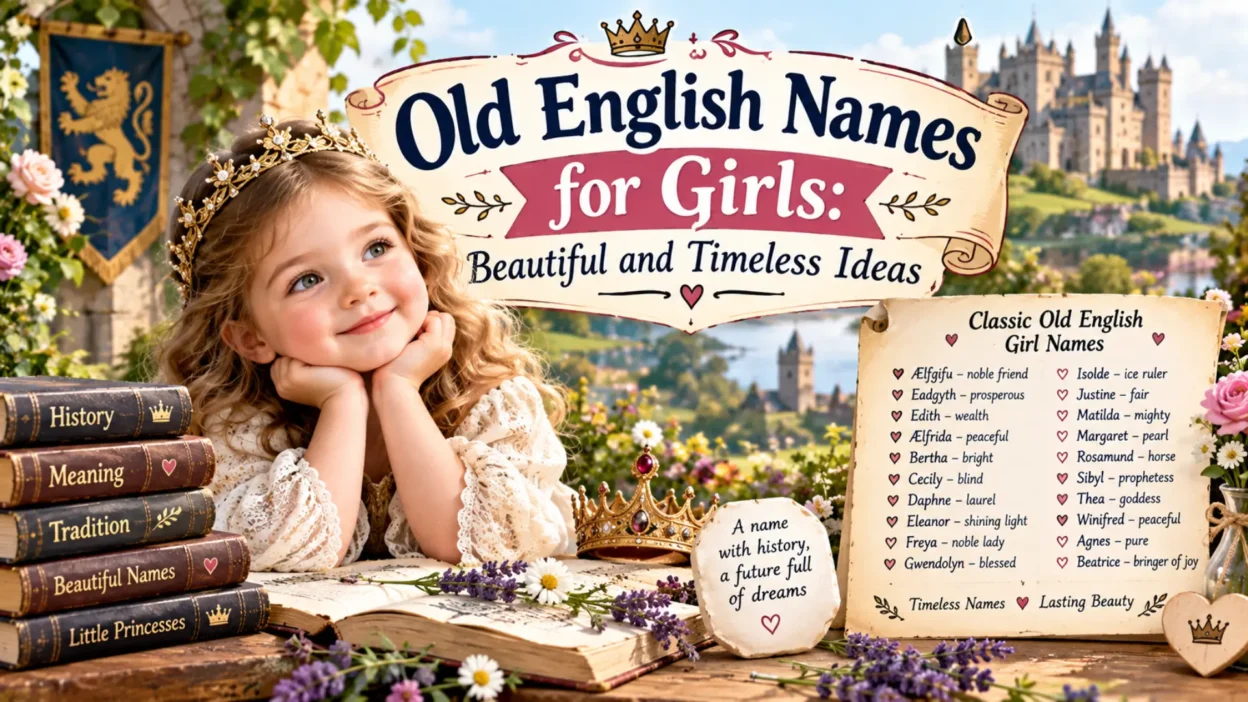
Old English Girl Names With Meanings
These selections include names with historical Germanic or Old English elements. Meanings can vary by spelling, period, and scholarly interpretation, so the descriptions are kept brief.
- Æthelflæd — noble beauty or noble form
- Ælfgifu — elf gift
- Ælfthryth — elf strength
- Eadgyth — prosperity and war
- Eadburh — prosperous stronghold
- Eadgifu — prosperity gift
- Godgifu — gift of God
- Leofgifu — beloved gift
- Wulfrun — wolf mystery or secret
- Wynflæd — joy and beauty
- Hild — battle
- Mildthryth — gentle strength
- Edith — wealth and battle
- Audrey — noble strength
- Ethel — noble
- Mildred — gentle strength
- Winifred — traditionally associated with peace and blessedness; its history is complex
- Matilda — strength in battle
- Emma — whole or universal
- Rose — rose flower
- Ivy — evergreen climbing plant
- Willa — traditionally associated with resolute protection
Rare Old English Names for Girls
Rare historical names can be appealing if you want something distinctive and connected to early English history. These choices may need a little explanation when spoken aloud.
- Ælfflæd
- Eadburh
- Eadgifu
- Ealdgyth
- Godgifu
- Leofgifu
- Leofrun
- Mildburg
- Mildthryth
- Wulfflæd
- Wulfrun
- Wynflæd
- Ælfthryth
- Æthelflæd
- Eadflæd
Unique Old English Names for Girls
Unique names can help a character or child stand out while preserving a connection to English history. Consider how each name looks on paper and sounds in everyday conversation.
- Ælfthryth
- Ælfgifu
- Eadgyth
- Eadgifu
- Ealdgyth
- Godgifu
- Leofrun
- Mildburg
- Wulfrun
- Wynflæd
- Elfrida
- Elfreda
- Etheldreda
- Avice
- Rowena
Cute Old English Names for Girls
Some names feel gentle, friendly, and easy to use from childhood through adulthood. These options include traditional English favorites as well as names with older historical connections.
- Elsie
- Edith
- Ethel
- Hilda
- Ivy
- Willa
- Winnie
- Nell
- Mabel
- Maud
- Rose
- Alice
- Emma
- Enid
- Audrey
Elegant Old English Names for Girls
Elegant names often have a graceful sound and a long history of use. These choices work well if you want something classic without sounding overly complicated.
- Audrey
- Edith
- Eleanor
- Elinor
- Elfrida
- Etheldreda
- Florence
- Matilda
- Rosamund
- Winifred
- Alice
- Beatrice
- Clara
- Grace
- Violet
Strong Old English Names for Girls
Historical names built around battle, strength, protection, or noble status can suit characters with bold personalities. Some are rare Anglo-Saxon forms, while others belong to the broader English tradition.
- Æthelflæd
- Ælfthryth
- Eadgyth
- Hild
- Hilda
- Hilde
- Mildred
- Audrey
- Matilda
- Willa
- Elfrida
- Alfreda
- Winifred
- Eadburh
- Eadgifu
Vintage Old English Names for Girls
Vintage names bring an old-fashioned charm that can feel fresh again. These choices have been used in English-speaking communities across different generations.
- Edith
- Ethel
- Mildred
- Winifred
- Matilda
- Maud
- Mabel
- Alice
- Agnes
- Enid
- Florence
- Harriet
- Ivy
- Olive
- Pearl
Short Old English Names for Girls
Short names are easy to spell, remember, and pair with longer middle names. This list mixes historically connected choices with familiar English names.
- Hild
- Ethel
- Edith
- Ivy
- Rose
- Nell
- Willa
- Emma
- Elsie
- Joan
- Ruth
- Mary
- Vera
- Nora
- Maud
Medieval Old English Names for Girls
Medieval names can bring historical depth to a story, game, or family naming project. These selections include Anglo-Saxon names and other names used in medieval England.
- Æthelflæd
- Ælfgifu
- Ælfthryth
- Eadgyth
- Eadburh
- Eadgifu
- Godgifu
- Leofgifu
- Hild
- Hilda
- Matilda
- Maud
- Edith
- Avice
- Aveline
Nature-Inspired Names From the English Tradition
Nature-inspired names offer a gentle connection to flowers, plants, and the natural world. Most of these are English-language choices rather than direct Old English personal names.
- Ivy
- Rose
- Rosemary
- Violet
- Olive
- Hazel
- Holly
- Heather
- Lily
- Daisy
- Willow
- Fern
- Briar
- Blossom
- Summer
Royal and Noble Old English Names for Girls
Anglo-Saxon naming traditions often used elements associated with nobility, prosperity, and status. The names below include historical figures’ names and familiar English names with noble associations.
- Æthelflæd
- Ælfthryth
- Eadgyth
- Eadburh
- Eadgifu
- Audrey
- Matilda
- Eleanor
- Edith
- Elfrida
- Rosamund
- Winifred
- Alice
- Beatrice
- Victoria
How to Choose the Perfect Old English Name for a Girl
Choosing a name becomes easier when you decide what matters most to you. Start by considering whether you prefer a historically authentic Anglo-Saxon name or a familiar English name with an old-fashioned feel. This distinction matters because the two groups do not have exactly the same origins.
Next, say your favorite names aloud. A name may look beautiful in writing but feel difficult to pronounce in daily conversation. If you choose a name with letters such as æ, decide whether you’ll preserve the historical spelling or use a modernized form.
Think about meaning, too. Some Old English names contain elements associated with nobility, prosperity, gifts, or battle. However, historical meanings can be uncertain, so check reliable references before making a final decision.
Consider nicknames and middle-name combinations. A longer name such as Æthelflæd may pair well with a short middle name, while Edith or Audrey can work beautifully on their own.
Finally, choose a name that feels right for your family or character. Historical authenticity, personal taste, and everyday practicality can all matter.
Common Mistakes to Avoid When Choosing an Old English Girl Name
One common mistake is assuming that every traditional English name comes from Old English. Names such as Rose, Violet, and Florence have different linguistic histories, even though they are well established in English.
Another mistake is relying on a single website for a name’s meaning. Historical spellings change, and some meanings remain debated. Check more than one trustworthy historical or linguistic source when accuracy matters.
Pronunciation is also worth considering. Names with letters such as æ may be unfamiliar to modern readers. You can keep the original spelling for historical authenticity or choose a recognized modern form when appropriate.
Avoid choosing a name based only on its appearance. Say it aloud, consider possible nicknames, and check how it pairs with the surname.
For fiction, also match the name to the character’s setting and time period. A modern-sounding name may not fit an early Anglo-Saxon setting.
Extra Inspiration: Old English Names for Stories, Characters, and Families
Old English names can be useful beyond baby naming. Writers, game designers, and history enthusiasts can use them to create characters with a stronger connection to a particular period or culture.
For an early medieval setting, historically attested names such as Æthelflæd, Ælfgifu, Eadgyth, and Eadburh offer a more authentic starting point. Their spellings and sounds can also help establish the atmosphere of an Anglo-Saxon community.
For historical fiction set in later medieval England, names such as Matilda, Maud, Alice, and Avice may fit better, depending on the date and location. For a fantasy story inspired by English history, you can combine historical names with familiar choices such as Hilda, Edith, or Winifred.
If you’re naming a real child, you may prefer a name that feels connected to history but remains simple to use today. Edith, Audrey, Ivy, and Matilda are examples of established English names with lasting appeal.
The key is to match the name to its purpose. Historical accuracy matters for some projects, while personal meaning and sound may matter more for others.
Frequently Asked Questions About Old English Names for Girls
What is an authentic Old English name for a girl?
Æthelflæd, Ælfgifu, Ælfthryth, Eadgyth, and Eadburh are examples of historically attested female names from the Anglo-Saxon period. They reflect naming traditions from early medieval England.
What do Old English girl names usually mean?
Many combine name elements associated with nobility, prosperity, gifts, battle, or personal qualities. Exact interpretations can vary, so historical meanings should be checked against reliable sources.
What are some rare Old English names for girls?
Rare choices include Ælfflæd, Eadgifu, Ealdgyth, Godgifu, Leofgifu, and Wulfrun. These names have historical character but may be unfamiliar to many modern readers.
Are Edith and Audrey Old English names?
Both have strong connections to the English naming tradition and historical Germanic roots. Edith is derived from Old English elements associated with wealth and battle, while Audrey developed from the Anglo-Norman form of an Old English name meaning noble strength.
Which Old English names are easy to use today?
Edith, Audrey, Ivy, Hilda, Willa, and Matilda are relatively familiar options. They offer a traditional feel without requiring most people to learn an unusual spelling.
How can I check the meaning of an Old English name?
Consult reputable historical name dictionaries, academic references, or specialist resources on Anglo-Saxon language and history. Check spelling variants and avoid treating uncertain interpretations as established facts.
Conclusion:
Old English names for girls offer a fascinating mix of history, character, and timeless appeal. From historically attested names such as Æthelflæd and Eadgyth to familiar English choices such as Edith, Audrey, and Matilda, there are options for many different tastes.
If you prefer a rare name with a strong historical connection, explore early Anglo-Saxon forms. If you want something easier to pronounce and spell, consider a traditional English name that remains familiar today. Both approaches can lead to a meaningful choice.
Take your time comparing pronunciations, historical origins, and possible nicknames. Remember that not every traditional English name is technically Old English, so check the background when historical accuracy matters.
Whether you’re choosing a baby name, building a fictional character, or exploring English heritage, let your favorite name reflect the qualities you value most. The right choice is one that feels meaningful to you and suits the person or story it represents.

Robert Thomas is a passionate name researcher and writer who explores the history, meanings, and cultural stories behind names from around the world. With a deep interest in baby names, pet names, fantasy names, and naming trends, he creates helpful guides that make finding the perfect name simple and inspiring. Robert focuses on sharing unique, meaningful, and timeless name ideas for families, writers, gamers, and anyone searching for a name with personality and purpose.